Friday, 19 July 2019

A Day Out At The Rare Breeds Show


 Spent a lovely day at  The Rare Breeds Show at Singleton, lots to see and do. I enjoy seeing the multitude of sheep, so many different colours and types of fleece.
 As wool is the main material for my craft as a spinner, weaver and knitter, it is so good to witness the care, love and pride in their flock that the farmers, smallholders, families indeed shepherds young and old bestow upon their animals.
It is so important to keep these rare breeds going, they are our heritage and our the future.


The Champions of the Show 

The show was in a perfect setting at the Weald and Downland Living Museum 


It is the location for the BBC Series The Repair Shop


As a living museum there is so much to do and see, demonstrations of old crafts from blacksmithing to milling, baking to weaving.
Beautiful old buildings with gardens planted out in the life long traditional way, so as to be used to supply the home for food, herbs and medicines and natural dyes.
These gardens were alive with colour, wildlife, birds, bees, butterflies. 
which can only be the best way to garden, happy, happy, happy.  

Sunday, 23 June 2019

Brief Jottings on June

 JUNE  

A few notes and jottings for this month. Cropping the first lavender - hanging up in the studio to dry. I will use it in my hand woven lavender bags and sachets. I always put fresh sprigs layered in my fleece and wool storage too.
Harvesting my woad seed - I will dry them and pop them in a paper bag to store ready for next year's sowing.


 Had so much fun with sticks and wool by weaving some very organic artful  stick/ branch weaving
They will be little woolly accents placed around the garden allowing the flowers and plants to grow and intertwine.


AND
I held my first "Learn to weave on a Rigid Heddle loom" workshop.

Back in my March post I said this was something I had been planning to do for a while, so it was really good to introduce and share the joy of weaving with two students and thrilling to see their happy faces as they went home clutching their very first weavings. 


Sunday, 26 May 2019

Coat Jacket - Hand Woven On My Saori Loom


Making the cloth
Here you can see the warp and weft of the cloth on the loom as I weave the colours and textures together.


Woven cloth rolled on the beam.


Newly woven cloth cut straight from the loom and laid out. Can  you see the small slits in the fabric at intervals through the right hand side of the cloth. These are where I wove the collar shapings as I created the weaving. It means that there is less cutting to do when I sew the jacket together so giving me a neater finish. 


Cutting and Washing the Cloth
I always have to take a deep breathe here. Double check, measure twice, cut once.


Then all the pieces are washed to Full the Fabric and hung out to dry on a lovely sunny day.


SEWING A GARMENT

 A little bit of sewing and the Jacket all comes together!
I hand knitted the drop sleeves, the collar and front trim.


THIS JACKET WAS HAND WOVEN AND INCLUDES HANDPAINTED AND NATURALLY DYED YARN WITH SOME HANDSPUN SLUBS IN THE CLOTH.
IT HAS HAND KNITTED SLEEVES AND FRONT TRIM.

WOVEN IN THE SAORI WAY, BEAUTIFULLY SLOW CLOTH.

Saturday, 13 April 2019

Daffodils! Natural Dyeing

 I love the Spring I'm enjoying the fresh new colours of the Season.
Time for some more natural dyeing, this month with some Daffodils.
 

Using just the flowerheads Bubbling up a nice Dye Bath.
 Straining the plant matter ready to add the pre- mordanted wool.


 I used some of my hand spun Shetland yarn.
 Rather than do an exhaust dip to produce a lighter shade of yellow I divided the dye bath solution into two pans. One pan I added soda ash at the start of the dye process, the other pan I added the soda ash right at the very end of the brewing.


 This gave me some subtle shades of yellow along with a nice depth of yellow colour.


 Here are the skeins hanging on our Woollen tree to dry in the Spring sunshine.


You can probably notice in this photo that the ties that secure the skeins and stop them from tangling  are of different colours to the yarn, here- red, navy and orange. I always use contrasting colours for my skeins so as I know where they are tied to avoid accidently snipping the yarn when balling them up. I have to be certain that the yarn I use for this task is colourfast of course so as not to corrupt my dye colours.  


A small sample of approximately 150g of Shetland hand spun wool, natural hand dyed with daffodils.
I just know it will come in handy for my knitting and weaving projects.

Wednesday, 27 March 2019

Room For A Loom


 Of Course! There is always room for another loom. This Ashford Rigid Heddle Loom needed a new home, it was looking very sorry for itself with an old woolly warp tied on and a gathering of dust and dirt to clean. But as a weaver I saw the potential in this old loom. It is in very good working order and all it needed was a little TLC to get it up and weaving again.


 A good wash and clean with wood soap.


 Then a visit to the WrightTurned work shop, where Skipper got all the working parts running smoothly and  gave it a wax polish treatment and buffed it up to a beautiful sheen.


All warped up and happily weaving once more 


An Ashford Rigid heddle Loom is a perfect loom for the beginner. It is simple to use. Using one is a great introduction to weaving and as I intend to offer "Learn to Weave" sessions in the future this little loom will be very useful. It will certainly find itself busy once more.
Meanwhile I shall use it for small projects when they come up.  


Sunday, 24 February 2019

Whorls, Weights and Beads - Ancient Ways


 Whenever I can I love to visit museums. I'm always looking out for anything to do with the craft of spinning, weaving and dyeing wool. I like to see old drop spindle whorls, weights for weaving looms and ancient beads for decoration. These are often made of clay or glass. Such small everyday objects are so fascinating as they give us an insight into the times past.

 A recent visit to Winchester museum inspired me to try and make some whorls, weights and beads of my own and I wanted to produce them in the old way. Now this is where having a sister who is a potter and a husband who is wood turner really comes in super handy!! 


 So first I begged some clay from my sister and made some very naïve simple shapes and forms. I pressed or drew various patterns into the clay form.

 Then allowed them to dry. I knew that my sister was going to do a "Pit Firing" so I handed my little whorls,weights and beads into her safe keeping and she was able to place them into her kiln.

Please pop over to her blog to read all about her Pit firing kiln session.


 I am absolutely thrilled with the results! The ancient way in which they have been fired means my little clay creations have taken on beautiful colours. The natural materials used in the pit to decorate them makes them unique.  


 Now I handed the whorls over to Skipper in his work shop where he hand turned a spindle to fit so as I could construct a Drop Spindle for hand spinning
 
I shall use the weights to tension any odd warp thread on my loom. I might use the beads in a knitting or weaving project by incorporating them into a bag or item of clothing.

The real adventure here was to try to understand and feel a little of the history of spinning, weaving and dyeing, so to have some whorls, weights and beads which look like the museum items that  inspired them gives me a happy smile.


Thursday, 31 January 2019

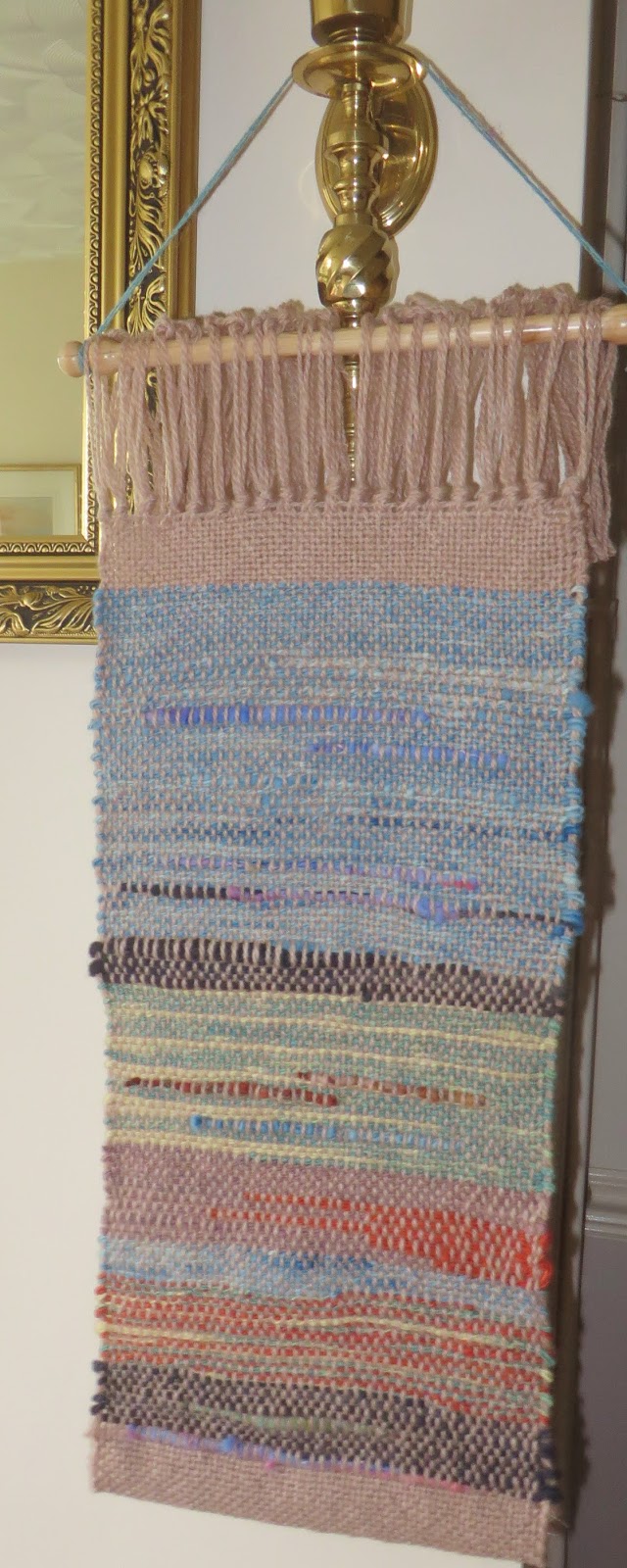
Weaving Part 2 -Woven Weft With Hand Spun Natural Dyed Wool

 Back in October last year, I blogged about the Warp of my weaving process. This post is about the next part of weaving to make the cloth.

 The Weft -This is the crosswise thread on my loom that passes over and under the warp to make the cloth.

For this particular project, "a small wall hanging", I chose some of my handspun wools which I had naturally dyed in my garden over the summer (please view earlier posts for this process).
A small selection of  Shetland, Jacob and Suffolk fleece were handspun on my wheel then dyed with various natural colour sources such as  woad, logwood, brazilwood and eucalyptus.


 The balls of wool always look so inspiring and beautiful together when naturally dyed.
I do a rough plan for how I want to weave the colours through, so as I develop a gradient flow of  colour in my work.


 The material is then wound on to either stick shuttles or my boat shuttles ready to weave the weft.


I love the rhythm of weaving, the absorbing nature of working with my hands and feet.
Slowly seeing the cloth grow and the colours blend together.


The thrill and satisfaction of taking a fresh fleece and spinning, dyeing and weaving it into something that is naturally beautiful.